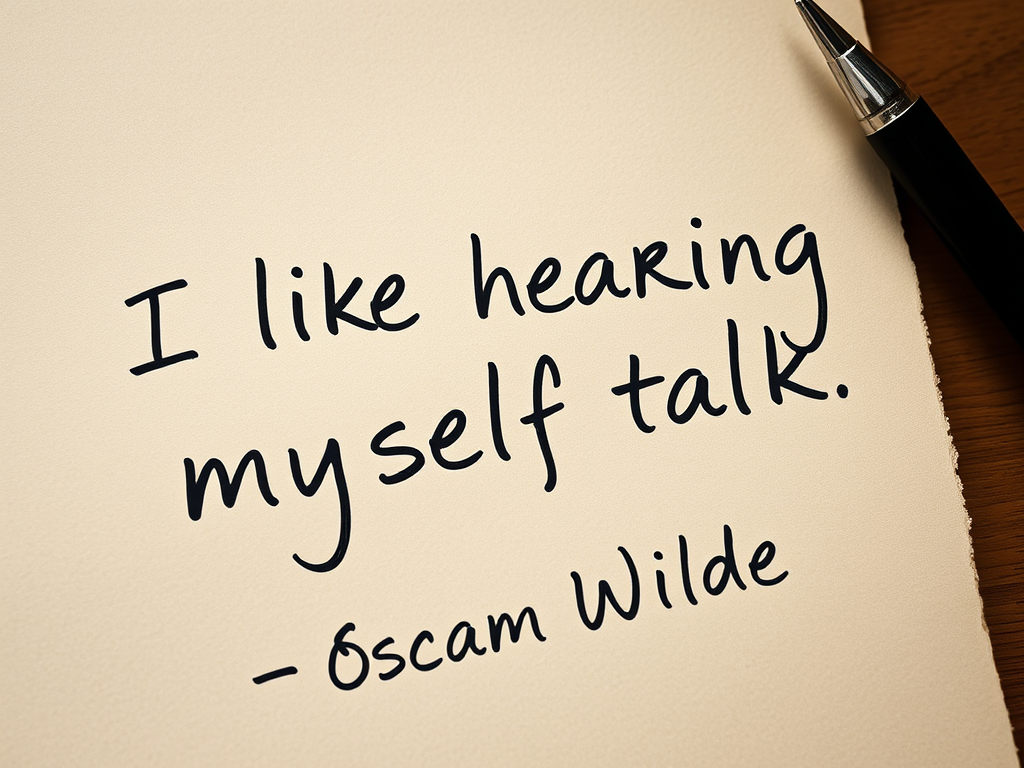
I don’t think I will ever feel this way, as the above statement by O.W. Nonetheless, it is important to feel this way. I wanted to tell you about how I use voice and language in my music. It’s quite a driving factor, since I am also invovled in opera. There is an excitement towards what I can’t do that drives what I love.
My work is driven by a deep fascination with the musicality of language—especially in Greek and English, and their many dialects. In my vocal compositions, I often play with the natural rhythm and contour of speech. Sometimes I follow the flow of a phrase with lyrical sensitivity; other times I disrupt it—breaking apart words, reshaping sounds, and creating vocal textures that heighten emotional tension.
One of my ongoing challenges is finding a balance between music and narration—ensuring that the music isn’t just accompanying the story, but is deeply connected to it. I often assign instruments to act as characters, like the trombone representing a father figure in The Death (Skipton Camerata, 2020). At other times, I weave in subtext, like in Silver Lines (2019), where a lullaby gently underpins the narrator’s voice, adding an extra emotional layer beneath the surface.
My fascination with language began while studying at the Ionian University in Corfu and deepened during my MA at the University of York. I became intrigued by how switching between Greek and English could subtly shift the melody, mood, and even meaning of a phrase. I started experimenting with how these shifts could influence a listener’s perception—creating sonic spaces where language, vocal expression, and music blend seamlessly, whether in jazz, opera, narration, or electronically manipulated speech.
Much of my work is also shaped by personal experience. Tillein, for an Intimate Percussionist was inspired by my own journey with trichotillomania—a compulsive hair-pulling disorder. In this piece, the percussionist whispers fragments of text while playing a gong, sometimes with their back to the audience, leaving behind incomplete traces of sound for the listener to interpret. Tillein was recently performed in Indiana, USA, by Dr. Alexandros Fragiskatos at PASIC.
Another recent piece, Statue of the Earth, was written for London-based violist Katherine Clarke. It’s a work for singing viola, where the sounds of Greek and English merge into a third, hybrid instrument. Soft consonants—like “sss,” “rrr,” and “fff”—intertwine with the viola and voice, forming a textured, vocal-instrumental layer. The piece draws inspiration from the goddess Hestia, blending mythology with my ongoing exploration of sound, home, and inner stillness.
 Rania Chrysostomou
Leave a comment